
Web users today demand websites that provide instant loading times and smooth navigation experiences. At the same time, brands require their designs to feature rich visual elements that create unique brand identities. This situation develops when designers need to choose between two competing design philosophies, which they should use to solve their design problems.
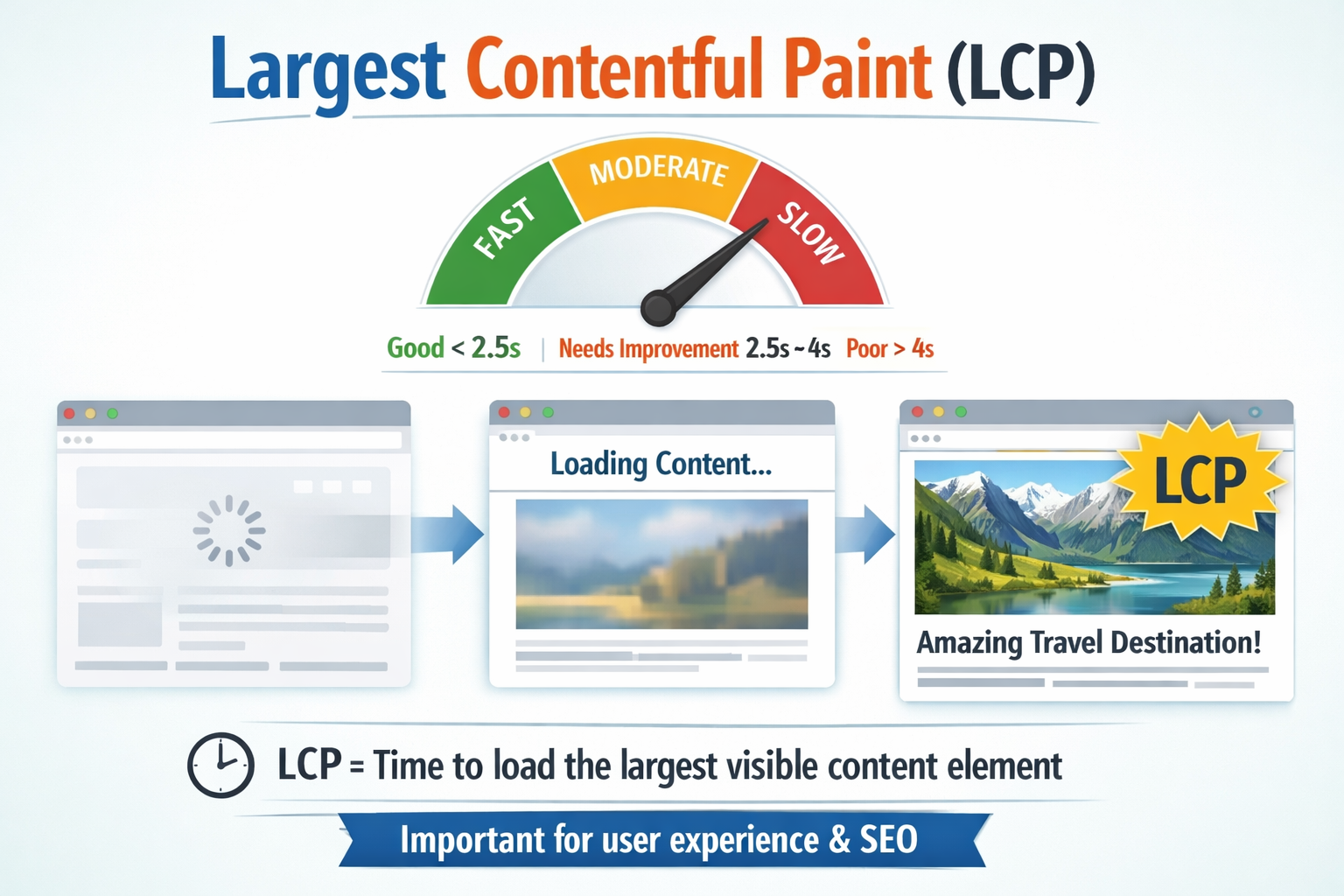
Designers who follow minimalism create products that combine three essential elements to achieve their design goals. The main focus of performance measurement in testing which users find most valuable, uses Largest Contentful Paint (LCP) as its main assessment tool. The challenge is not choosing one over the other but finding the right balance between both.
The following points demonstrate that minimalism and performance can achieve successful results through their partnership instead of competing against one another with the Web Design Company India.
1. Understanding What LCP Really Means
The LCP metric measures the time needed for users to see the largest content element on a webpage, which includes elements like hero images and headlines. The website speed that users experience depends on this element of the site.
A faster LCP creates a sense of instant responsiveness. Users perceive the website as fully operational even though the remaining content continues to load. A slow LCP, on the other hand, creates frustration and increases bounce rates.
LCP operates as a more advanced metric because it shows technical data while also demonstrating how users experience a website. The evaluation process needs to consider both perceived and actual performance metrics.
2. Minimalism Is Not Merely Taking Away; It's About Being Responsible
There is a common misconception that minimalism is all about eliminating elements. However, it is actually about giving the emphasis to hardly true matters.
A minimalism method does not only merely help to highlight the main elements. It can also get rid of the unnecessary ones, allowing the users to find the things they're looking for much faster. This way, the performance is going to be greatly improved since having fewer elements to show means having fewer elements that require resources for loading.
On the other hand, minimalism that is not well done can be perceived as empty or dull. You do not have to remove everything to achieve minimalism, but you have to create purposeful and thoughtful designs.
3. Over-Designed Pages Can Lead to LCP Problems
Many contemporary websites depend on using large-scale images, videos, animations, and gamified features. Although these increase the attractiveness of the sites, they can also cause the loading time to become very long.
The main source of big LCP problems is large frontal images. If they are not optimally prepared, the users will have to wait the longest for the part of the page that is most important to them to be shown.
The challenge lies in making the site just as appealing and exciting visually while also loading it quickly. Each design element that is added should be able to justify its negative impact on the performance.
4. Focus on Above-the-Fold Content
The portion that visitors notice right away, above the fold, is most important for LCP. This also happens to be the location of the largest content piece.
Making this partition as simple and centred as possible can lead to a significant rise in performance. Favour the use of compressed pictures, system fonts, and reduced scripts to guarantee a speedy rendering process.
However, the first thing that users see can and should still have a "wow" factor. Both speed and appeal can be achieved by a design that is neat, yet impactful.
5. Clever Deployment of Images and Media
Usually, pictures occupy the largest space among the assets that are used on a web page. Optimizing them is a great opportunity to significantly get better LCP.
Significant improvements can be achieved by choosing the latest formats, reducing the file sizes, and loading only the necessary elements. Lazy loading can be used for images below the fold, making sure that the content that is most important is displayed first.
This method enables sites to hold images and video content without performance loss.
6. Typography and Simplicity
Fonts contribute significantly to both the aesthetics and the efficiency of a website. While unique fonts that reflect the brand can be visually appealing, they also run the risk of hampering the speed if the loading isn't optimized properly.
Minimizing the number of font families and weights is one of the ways in which minimalism can be applied to fonts. This decreases the number of elements required for loading.
You are able to hold on to your style while at the same time raising the speed by picking up web-safe or optimized fonts, which will make the user's experience even more enjoyable.
7. Reducing JavaScript Overload
Lots of websites are dependent on JavaScript for various forms of interaction. It is indeed a great addition to a website in terms of functionality but if it is overly used, then it may also cause a delay in rendering and might have an impact on the LCP.
Usually, a minimalist approach to design results in less usage of scripts, which automatically leaves the website performance in a better state. Getting rid of code that is no longer used and pushing back the loading of scripts that are not immediately necessary can give an even better result in terms of speed.
The main challenge is to make sure that the use of JavaScript is done in such a way that it is really beneficial for the website and not just used for adding visual effects.
Finding the optimal balance between simple design and fast performance
The current design principles of LCP performance require designers to find the optimal point between minimalistic design and high-performance results. Minimalism provides users with clear understanding through its basic design, which eliminates unnecessary elements. The combination of these elements creates websites that present a modern aesthetic while delivering fast and easy-to-use navigation. The actual achievement results from designers making purposeful design choices and applying effective optimization methods and understanding how users interact with their products. Businesses create digital experiences that combine aesthetic appeal with exceptional performance when they focus on essential elements while removing unnecessary components that do not contribute value.
Also Read: Solving Cumulative Layout Shift (CLS): Common Design Mistakes That Kill Rankings